History of Hockey
Buried deep in Egypt’s Nile Valley lies the village of Beni Hasan, known for its ancient cliff tombs dating fro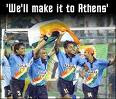 m 2000 BC. A drawing decorates one tomb, showing two men holding sticks with curved ends and
  standing over a ball. Add synthetic turf and shin guards, and it might pass for hockey at the Sydney 2000 Olympic Games.
AddMe - Search Engine Optimization
One of the world’s oldest known sports, hockey predates the Ancient Games of Olympia by perhaps 1200 years or more. Indeed, historians believe it existed in many of the world’s early civilizations.Do you know you can earn a fully accredited online degree while working full time? Do you know that many students qualify for scholarships , tuition payment plans, and/or credit for prior coursework or experience? Check out the top twenty online colleges and universities and research your educational options.
The Arabs, Greeks, Romans, Persians and Ethiopians all played variations of the game. Several centuries before Christopher Columbus found his New World, the Aztec Indians were playing it in Central America. The Araucano Indians of Argentina invented a game similar to hockey called Cheuca, believing it would make them better warriors.
Yet, the term `hockey’ is believed to be of French origin. A 16th century Irish document refers to `hockie’, but the term probably comes from the French hocquet, meaning `a shepherd’s crook.’
The modern game we know as hockey - or field hockey, for those distinguishing it from ice hockey - evolved in the British Isles in the 19th century. It was a popular English school game, possibly adapted from the Irish game of hurling.
The British army helped spread hockey internationally through the British Empire, its popularity especially booming in India and Pakistan. The London Hockey Association formed in 1886, and rules soon were standardised. The International Hockey Federation (FIH) formed in Paris in 1924, and the International Federation of Women’s Hockey followed in 1927.
Men’s hockey first appeared at the 1908 Olympic Games in London. It reappeared in Antwerp in 1920, then returned to stay at the 1928 Amsterdam Games. Women’s hockey waited much longer, finally debuting in 1980.
"India won six straight Olympic gold medals while winning 24 consecutive matches between 1924 and 1956, a record likely to stand through the ages. The Indians have won two more gold since then."
One name evokes the memory of their dominance: Balbir Singh. It’s one name, five people. The first Balbir Singh played with the great Indian teams of 1948, 1952 and 1956, his glory peaking at Helsinki in 1952 when he scored five goals in a 6-1 gold medal victory over the Netherlands. The four later Balbir Singhs played with the later Indian champions.
Pakistan finally broke India’s hold on the sport in 1960, a decade when the two would keep taking the gold from each other.
Now, as the Dutch men and Australia’s women head into Sydney as defending champions, no team has won consecutive gold since the legendary Indian run.
 m 2000 BC. A drawing decorates one tomb, showing two men holding sticks with curved ends and
  standing over a ball. Add synthetic turf and shin guards, and it might pass for hockey at the Sydney 2000 Olympic Games.
AddMe - Search Engine Optimization
One of the world’s oldest known sports, hockey predates the Ancient Games of Olympia by perhaps 1200 years or more. Indeed, historians believe it existed in many of the world’s early civilizations.Do you know you can earn a fully accredited online degree while working full time? Do you know that many students qualify for scholarships , tuition payment plans, and/or credit for prior coursework or experience? Check out the top twenty online colleges and universities and research your educational options.
The Arabs, Greeks, Romans, Persians and Ethiopians all played variations of the game. Several centuries before Christopher Columbus found his New World, the Aztec Indians were playing it in Central America. The Araucano Indians
 of Argentina invented a game similar to hockey called Cheuca, believing it would make them better warriors.
Yet, the term `hockey’ is believed to be of French origin. A 16th century Irish document refers to `hockie’, but the term probably comes from the French hocquet, meaning `a shepherd’s crook.’

The modern game we know as hockey - or field hockey, for those distinguishing it from ice hockey - evolved in the British Isles in the 19th century. It was a popular English school game, possibly adapted from the Irish game of hurling.
The British army helped spread hockey internationally through the British Empire, its popularity especially booming in India and Pakistan. The London Hockey Association formed in 1886, and rules soon were standardised. The International Hockey Federation (FIH) formed in Paris in 1924, and the International Federation of Women’s Hockey followed in 1927.
Men’s hockey first appeared at the 1908 Olympic Games in London. It reappeared in Antwerp in 1920, then returned to stay at the 1928 Amsterdam Games. Women’s hockey waited much longer, finally debuting in 1980.
"India won six straight Olympic gold medals while winning 24 consecutive matches between 1924 and 1956, a record likely to stand through the ages. The Indians have won two more gold since then."
One name evokes the memory of their dominance: Balbir Singh. It’s one name, five people. The first Balbir Singh played with the great Indian teams of 1948, 1952 and 1956, his glory peaking at Helsinki in 1952 when he scored five goals in a 6-1 gold medal victory over the Netherlands. The four later Balbir Singhs played with the later Indian champions.
Pakistan finally broke India’s hold on the sport in 1960, a decade when the two would keep taking the gold from each other.
Now, as the Dutch men and Australia’s women head into Sydney as defending champions, no team has won consecutive gold since the legendary Indian run.
History Of Hockey In India
Even though many ancient civilizations played hockey in different variations, the modern game of hockey--the field hockey-evolved in the British Isles in the 19th century. Hockey was introduced in India by British Army regiments and the game soon found favour among the native Indians. The first hockey club in India came up in Calcutta in 1885-86 and soon Bombay and Punjab followed suit. Making its Olympic debut at the 1928 Amsterdam Games, Indian hockey team cruised home to its first Olympic gold without conceding a single goal. The hallmark of this ruthless domination was the wizardry of Indian hockey legend Dhyan Chand who mesmerized the Amsterdam crowd with his dazzling skills.From 1928 to 1956, the Indian hockey juggernaut won six straight Olympic gold medals while winning 24 consecutive matches. This was the golden era of Indian hockey when India loomed large in world hockey and produced some of the finest players the game has ever seen.The Indian stranglehold over the Olympic hockey gold came to an end when Pakistan defeated India in the final of the 1960 Rome Olympics.
Field hockey
Field hockey game at Melbourne University.
Field hockey is played on gravel, natural grass, sand-based or water-based artificial turfs, with a small, hard ball. The game is popular among both males and females in many continents of the world, particularly in Europe, Asia, Australasia, and South Africa. In most countries, the game is played between single-sex sides, although it can be played by mixed-sex sides. In the United States and Canada it is played predominantly by women.
The 116-member governing body is the International Hockey Federation (FIH). Field Hockey has been played at each summer Olympic Games since 1908 (except 1924). Modern field hockey sticks are J-shaped and constructed of a composite of wood, glass fibre or carbon fibre (sometimes both) and have a curved hook at the playing end, a flat surface on the playing side and curved surface on the rear side.
There are 4000-year-old drawings in Egypt of a game resembling field hockey being played.[citation needed] While modern field hockey appeared in the mid-18th century in England, primarily in schools, it was not until the first half of the 19th century that it became firmly established. The first club was created in 1849 at Blackheath in south-east London. Field Hockey is the National Game of India.
Ice hockey
The Barrie Colts applying pressure at the Brampton Battalion net in an ice hockey game.Search Engine Optimization
Ice hockey is played on a large flat area of ice, using a three inch (76.2 mm) diameter vulcanized rubber disc called a puck. This puck is often frozen before high-level games to decrease the amount of bouncing and friction on the ice. The game is contested between two teams of skaters. The game is played all over North America, Europe and in many other countries around the world to varying extent. It is the most popular form of sport in Canada and in Finland.
The 64-member governing body is the International Ice Hockey Federation, (IIHF). Men's ice hockey has been played at the Winter Olympics since 1924, and was in the 1920 Summer Olympics. Women's ice hockey was added to the Winter Olympics in 1998. North America's National Hockey League (NHL) is the strongest professional ice hockey league, drawing top ice hockey players from around the globe. The NHL rules are slightly different from those used in Olympic ice hockey - the periods are 20 minutes long, counting downwards. There are three periods.
Ice hockey sticks are long L-shaped sticks made of wood, graphite, or composites with a blade at the bottom that can lie flat on the playing surface when the stick is held upright and can curve either way, legally, as to help a left- or right-handed player gain an advantage. Variations in curves include its lie and its curve type. Most companies that produce sticks have sponsored players and in return, use their custom curve on publicly retailed sticks. To shoot with a left curved stick, the stick is held with the right hand at the top and the left hand partway down the shaft. To shoot with a right curved stick, the stick is held with the left hand at the top and the right hand partway down the shaft. Most people who are right handed shoot with a left curved stick, and most people who are left handed shoot with a right curved stick. This keeps their dominant hand at the top of the stick, allowing more control. Sticks also have flex numbers, a number on the stick that can go from zero to 100. It indicates how much the stick will bend before breaking when pressed on the ice. This flexing is what enables slapshots.
There are early representations and reports of hockey-type games being played on ice in the Netherlands, and reports from Canada from the beginning of the nineteenth century, but the modern game was initially organized by students at McGill University, Montreal in 1875 who, by two years later, codified the first set of ice hockey rules and organized the first teams.
Search Engine Optimization and SEO Tools
Field hockey game at Melbourne University.
Field hockey is played on gravel, natural grass, sand-based or water-based artificial turfs, with a small, hard ball. The game is popular among both males and females in many continents of the world, particularly in Europe, Asia, Australasia, and South Africa. In most countries, the game is played between single-sex sides, although it can be played by mixed-sex sides. In the United States and Canada it is played predominantly by women.
The 116-member governing body is the International Hockey Federation (FIH). Field Hockey has been played at each summer Olympic Games since 1908 (except 1924). Modern field hockey sticks are J-shaped and constructed of a composite of wood, glass fibre or carbon fibre (sometimes both) and have a curved hook at the playing end, a flat surface on the playing side and curved surface on the rear side.
There are 4000-year-old drawings in Egypt of a game resembling field hockey being played.[citation needed] While modern field hockey appeared in the mid-18th century in England, primarily in schools, it was not until the first half of the 19th century that it became firmly established. The first club was created in 1849 at Blackheath in south-east London. Field Hockey is the National Game of India.
Ice hockey
The Barrie Colts applying pressure at the Brampton Battalion net in an ice hockey game.Search Engine Optimization
Ice hockey is played on a large flat area of ice, using a three inch (76.2 mm) diameter vulcanized rubber disc called a puck. This puck is often frozen before high-level games to decrease the amount of bouncing and friction on the ice. The game is contested between two teams of skaters. The game is played all over North America, Europe and in many other countries around the world to varying extent. It is the most popular form of sport in Canada and in Finland.
The 64-member governing body is the International Ice Hockey Federation, (IIHF). Men's ice hockey has been played at the Winter Olympics since 1924, and was in the 1920 Summer Olympics. Women's ice hockey was added to the Winter Olympics in 1998. North America's National Hockey League (NHL) is the strongest professional ice hockey league, drawing top ice hockey players from around the globe. The NHL rules are slightly different from those used in Olympic ice hockey - the periods are 20 minutes long, counting downwards. There are three periods.
Ice hockey sticks are long L-shaped sticks made of wood, graphite, or composites with a blade at the bottom that can lie flat on the playing surface when the stick is held upright and can curve either way, legally, as to help a left- or right-handed player gain an advantage. Variations in curves include its lie and its curve type. Most companies that produce sticks have sponsored players and in return, use their custom curve on publicly retailed sticks. To shoot with a left curved stick, the stick is held with the right hand at the top and the left hand partway down the shaft. To shoot with a right curved stick, the stick is held with the left hand at the top and the right hand partway down the shaft. Most people who are right handed shoot with a left curved stick, and most people who are left handed shoot with a right curved stick. This keeps their dominant hand at the top of the stick, allowing more control. Sticks also have flex numbers, a number on the stick that can go from zero to 100. It indicates how much the stick will bend before breaking when pressed on the ice. This flexing is what enables slapshots.
There are early representations and reports of hockey-type games being played on ice in the Netherlands, and reports from Canada from the beginning of the nineteenth century, but the modern game was initially organized by students at McGill University, Montreal in 1875 who, by two years later, codified the first set of ice hockey rules and organized the first teams.
Search Engine Optimization and SEO Tools


